
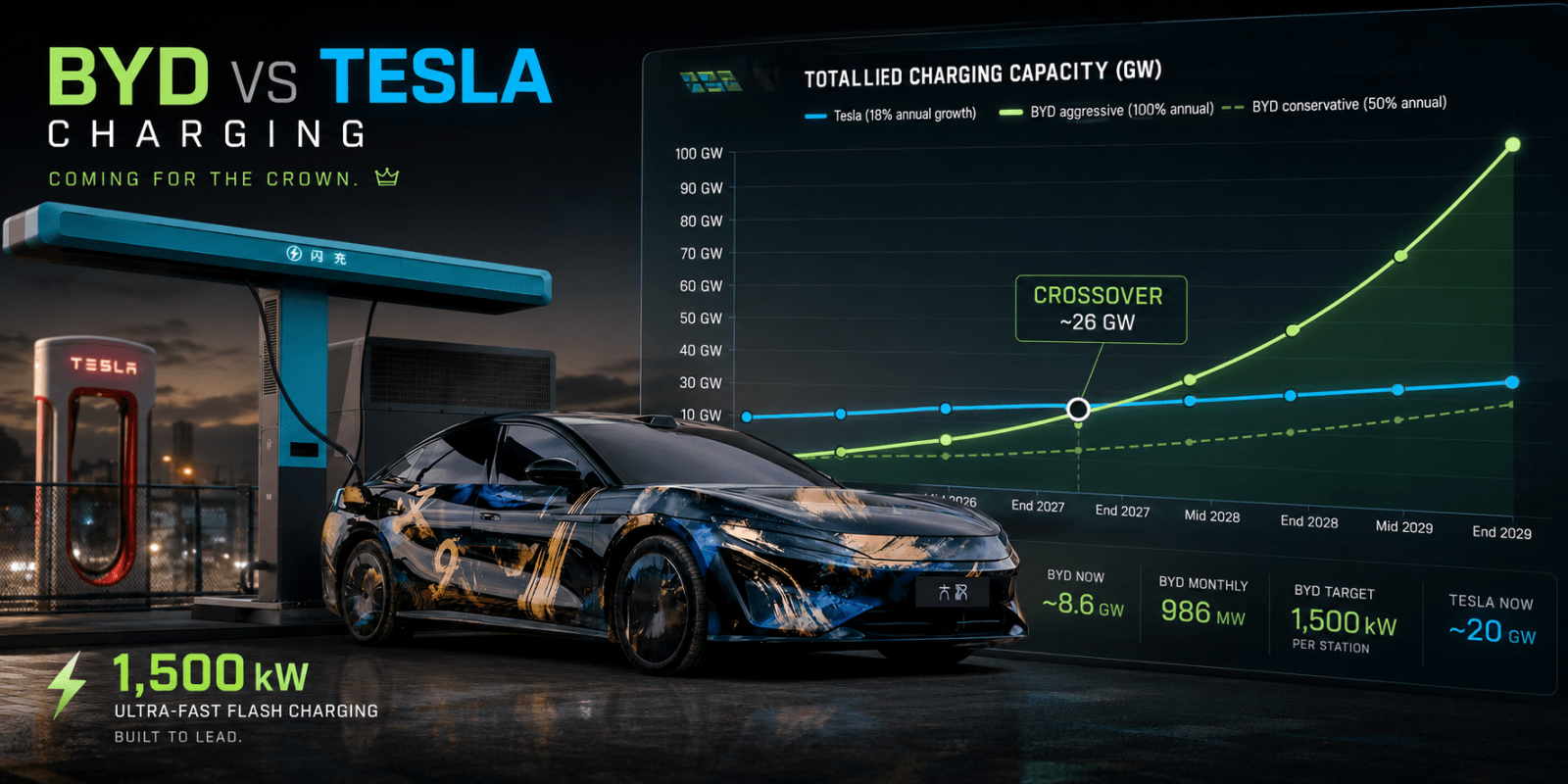
BYD is building a charging network that makes Tesla’s Supercharger look slow — and it’s deploying it at a pace that could see it surpass Tesla’s global network within two to three years.
The Chinese automaker has already deployed over 5,700 Flash Charging stations in China in just a few months and just opened its first overseas stations in Europe. The chargers deliver up to 1,500 kW of power — three times what Tesla’s latest V4 Superchargers can do.
I’ve long maintained that the Supercharger network is the single best thing Tesla has done for the EV revolution. Before the Supercharger network, the idea of long-distance EV travel was a fantasy. Tesla didn’t just build chargers — it built the confidence that made millions of people willing to buy an electric car for the first time.
But now, for the first time, someone is mounting a serious challenge to Tesla’s charging dominance. And I think it’s the best thing that could happen for EV adoption.
BYD’s charging specs crush Tesla’s — on paper
The numbers are hard to ignore. BYD’s Flash Charging system delivers up to 1,500 kW to compatible vehicles, compared to Tesla’s V4 Supercharger maximum of 500 kW. On a BYD vehicle equipped with the new Blade Battery 2.0 and its 1000V architecture, that translates to a 10% to 70% charge in five minutes, and 10% to 97% in nine minutes.
Tesla’s current vehicles, by comparison, max out at 250 kW for most models (500 kW for Cybertruck). Even with V4 hardware capable of 500 kW, Tesla doesn’t yet have passenger vehicle that can take advantage of the latest full output of BYD’s charging stations.
BYD is already rolling the Flash Charging tech into its best-selling EVs, not just luxury models. The updated Yuan Plus (Atto 3), one of the world’s best-selling EVs with 224,000 units sold in 2025, now supports Flash Charging at a starting price of around $17,700 in China.
The deployment rate is staggering
BYD launched its Flash Charging network on March 5, 2026. It hit 5,000 stations just 27 days later. By early May, the network had grown to 5,715 stations across more than 300 Chinese cities. BYD’s target: 20,000 stations in China by the end of 2026.
It sounds impossible, but when you look at the current deployment rate, it makes you believe in the impossible.
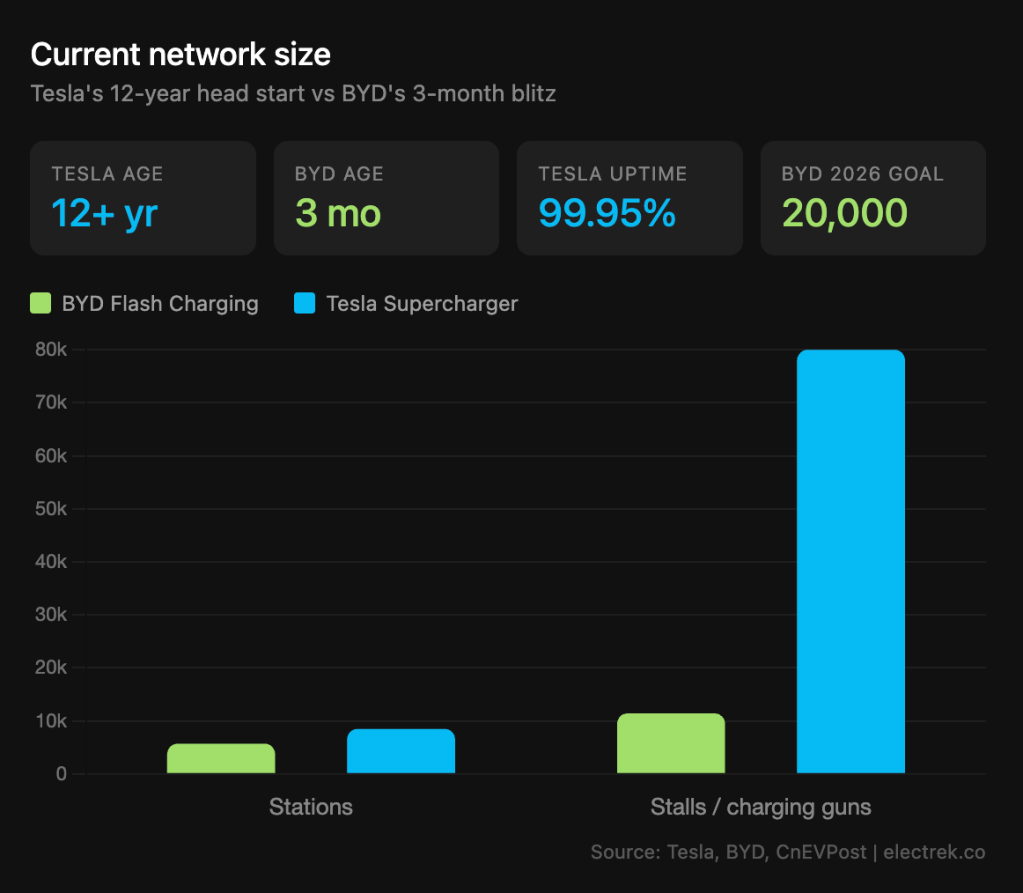
For context, Tesla’s entire global Supercharger network — built over more than a decade — consists of roughly 8,500 stations with 80,000 stalls. Tesla added about 2,500 stalls globally in Q1 2026, or roughly 833 per month.
BYD is deploying at roughly 650-700 stations per month and accelerating.
Now, it’s important to point out that BYD calculates things differently: each station has two charging guns. Therefore, it’s better to compare Tesla’s Supercharger stall deployment to 2x BYD’s station deployment, which puts BYD’s stall-equivalent deployment rate above Tesla’s current pace.
BYD’s partnership with Sinopec, China’s largest fuel retail network with over 30,000 stations, could supercharge this rollout even further. And the company just opened its first Flash Charger in Germany with plans for 3,000 stations across Europe and 6,000 total overseas by end of 2027.
When does BYD surpass Tesla?
Running the numbers, the answer depends on whether BYD sustains its current trajectory. If both companies continue at their current growth rates — Tesla at roughly 18% annual growth, BYD at the pace implied by its 2026 targets — BYD’s network (measured in stall-equivalents) could surpass Tesla’s globally between 2029 and 2030 – in just roughly 4 years.
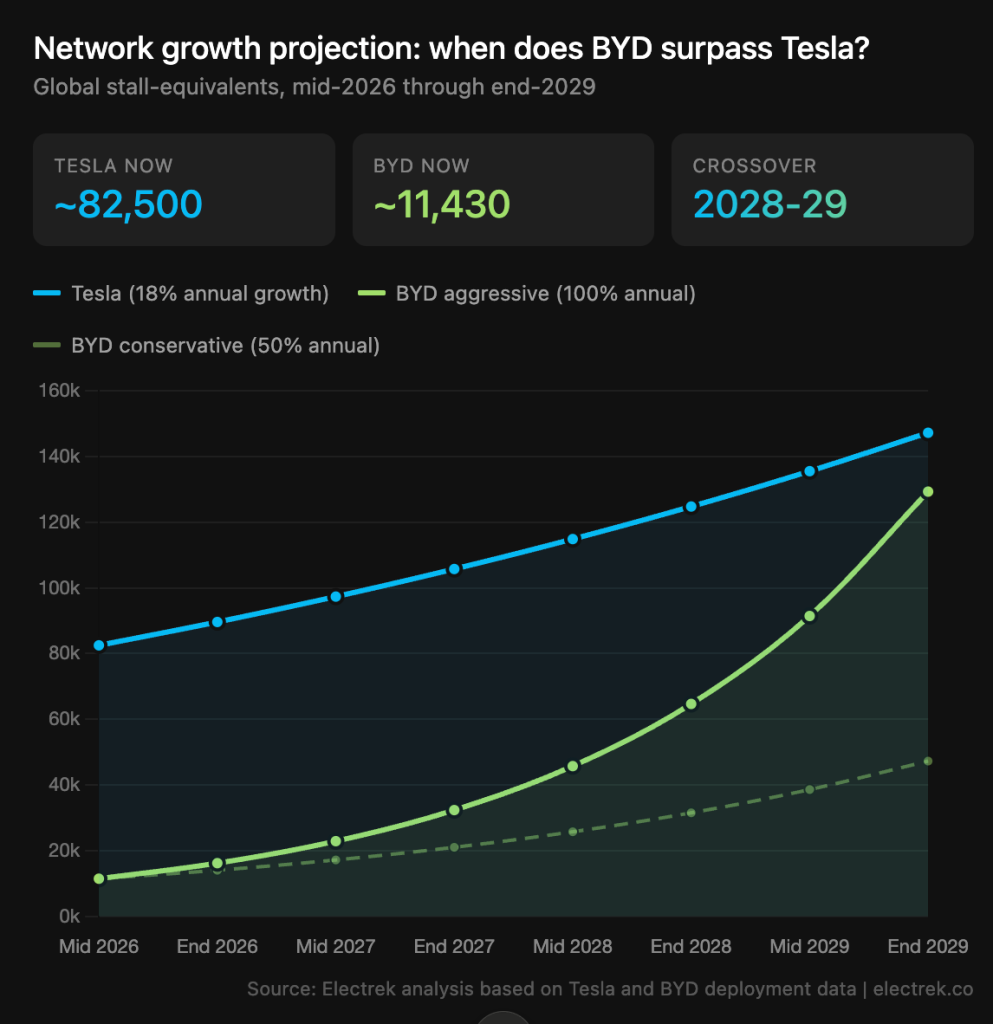
In China specifically, BYD will likely match or exceed Tesla’s local charging presence within the next 12 to 18 months. Tesla has roughly 3,000 stations across all of Asia-Pacific.
Tesla’s moat isn’t just hardware, though. It’s 12 years of route planning data, 99.95% uptime reliability, deep software integration, and the NACS standard victory that has turned every other automaker’s vehicles into Supercharger network customers. BYD can’t replicate that overnight.
However, there’s another way to look at it, too, and that’s power deployment.
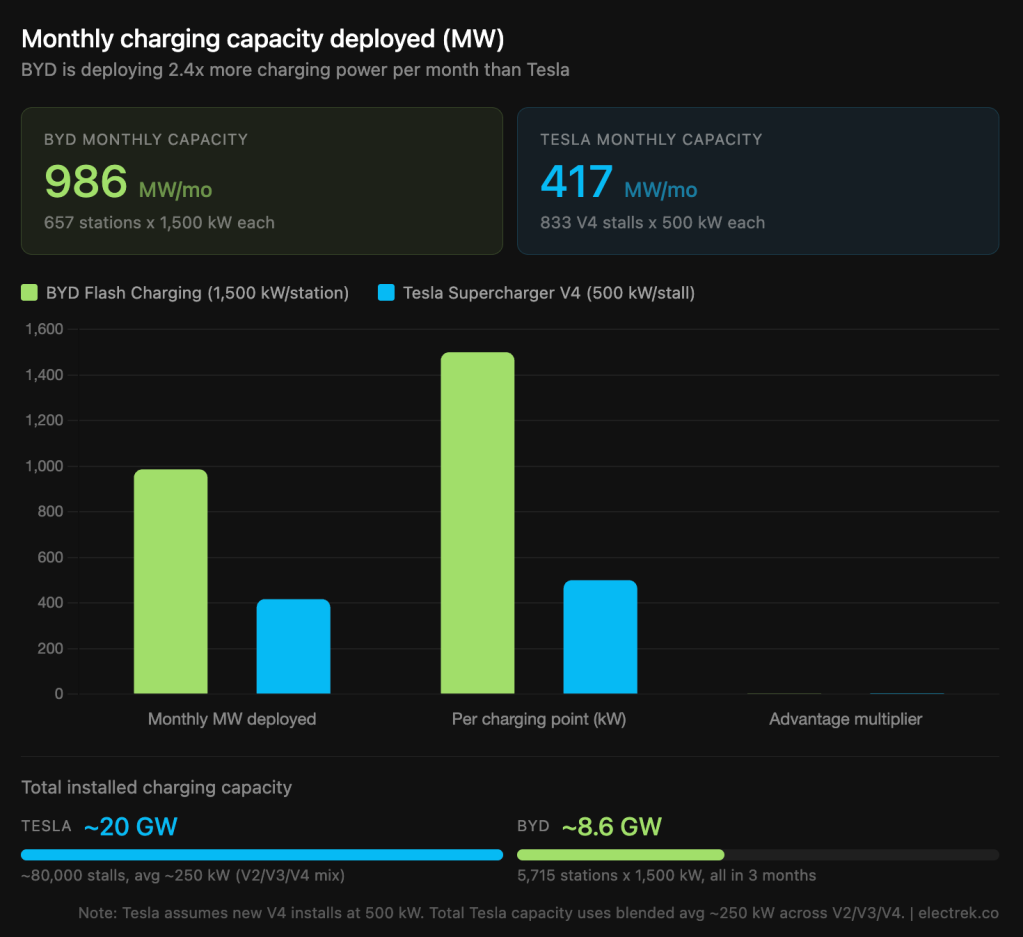
Based on power deployment, BYD is already doubling Tesla’s monthly deployment rate.
In fact, at this rate, BYD could surpass Tesla’s total charging power deployment within the next 2 years:
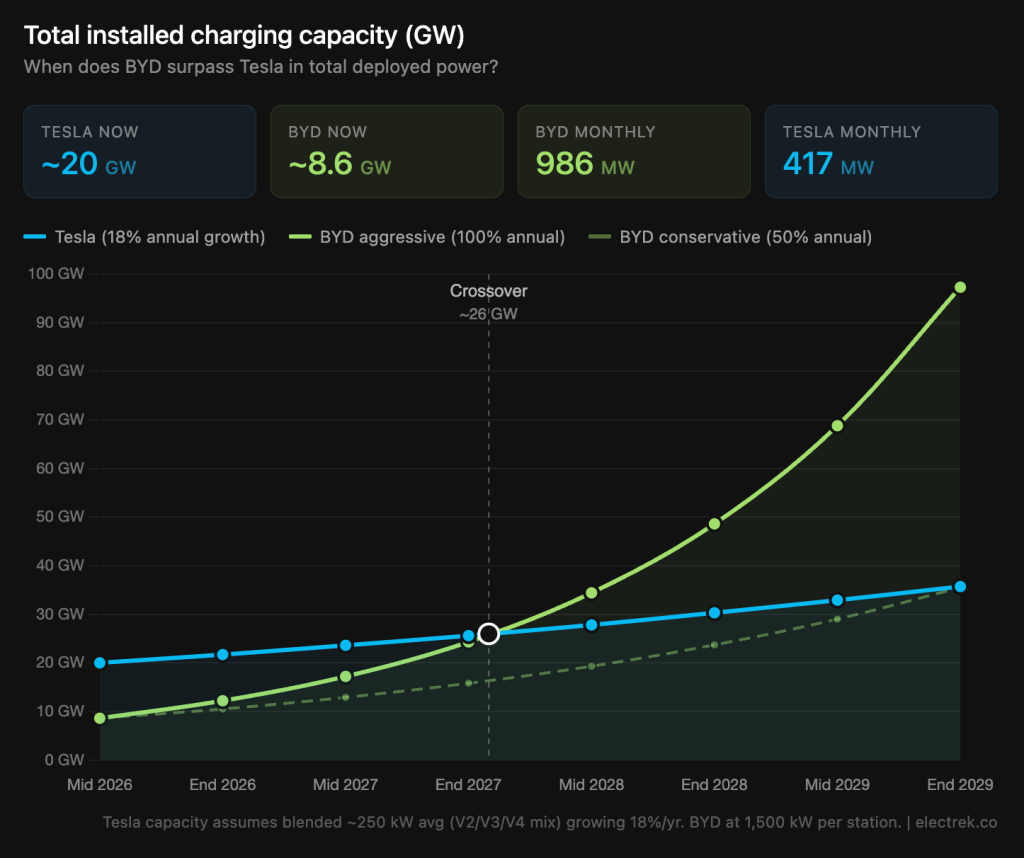
Of course, Tesla could also increase its own charging power, and it is already doing so with its Megacharger stations for the Tesla Semi. The deployment rate on those remains to be verified, as it is still early days.
The best thing for EV adoption
Here’s the thing: this competition is exactly what the EV industry needs. Tesla built the Supercharger network when no one else would. It proved that a reliable, fast charging network could make EVs viable for the mass market. But one company running the dominant charging network — even one as good as Tesla — isn’t a healthy long-term setup for the industry.
BYD entering the charging infrastructure game pushes the entire industry forward. Charging speeds go up. Prices come down. Coverage expands. Tesla will have to respond to BYD’s 1,500 kW chargers with faster hardware and vehicles that can actually use V4’s full 500 kW potential. That’s good for everyone.
BYD’s chargers use CCS2 connectors in Europe and are open to all EVs — not just BYD vehicles. BYD UK’s country manager has said the company is targeting sub-50 pence per kWh pricing, which would undercut Tesla Superchargers and most other fast-charging networks in Europe.
The bummer for American EV owners
The one downside in all of this: American EV owners are almost certainly going to be left out.
With 100% tariffs on Chinese EVs, a connected vehicle software ban, and BYD currently embroiled in political and legal battles with the US government over trade restrictions, there’s virtually no chance BYD’s Flash Charging network will make it to the United States anytime soon. American protectionism is going to keep one of the most impressive EV charging innovations in the world out of the country.
That means the rest of the world — Europe, Southeast Asia, Australia, the Middle East — will benefit from this competition between Tesla and BYD, while American EV owners will not. US consumers will be stuck with the Supercharger network (which, to be fair, is excellent) and networks like Electrify America (which are not), without the competitive pressure that BYD’s chargers would bring.
Electrek’s Take
Top comment by Philip234
Tesla needs to reinvest in the SuperCharger or it is going to start looking like chademo by 2030. Already there are - in the US which is very far behind - more 800V stations (2,400) and more 800V outlets (11,000) than there were total Tesla superchargers five years ago. As the industry moves beyond the old 400V architecture pioneered more than ten years ago, the SC network needs to keep up or get passed by.
I’ll say it again: the Tesla Supercharger network is the best thing Tesla has done for the EV revolution. Full stop. It created the template for what EV charging should look like — fast, reliable, well-placed, and integrated into the ownership experience. Every other automaker benefited from Tesla proving this model could work.
But Tesla having the best network doesn’t mean it should be the only serious network. BYD deploying 1,500 kW chargers that can go from 10% to 70% in five minutes — and doing it at a pace that makes Tesla’s deployment look slow — is a competitive wake-up call that should make everyone in the EV charging space move faster.
We’ve been covering BYD’s Flash Charging rollout over the past several months, and the speed of execution has been remarkable. The only real shame is that US trade policy will likely prevent American consumers from ever seeing these chargers domestically. Competition is good. Protectionism that shields consumers from better, faster, cheaper charging is not.
If you’re an EV owner looking to cut your charging costs at home, solar is still the best long-term play. With electricity rates climbing nearly 10% last year, home solar protects you against future rate increases. And with lease and PPA options, you can go solar with zero upfront cost and start saving immediately. If you want to find the best deal, check out EnergySage. It’s a free service with hundreds of pre-vetted installers competing for your business, so you save 20 to 30% compared to going it alone. No sales calls until you pick an installer. Get your free quotes here.


FTC: We use income earning auto affiliate links. More.


Comments